
YES, you should mulch your trees, as long as you lay down the mulch correctly.
Mulch has many benefits, including preventing disease, adding nutrients to the soil, and helping a tree conserve water. Mulch also protects soil from extreme temperatures by keeping it cooler in hot conditions and warmer in cold conditions. Finally, mulch helps prevent soil from getting compacted, which starves a tree of oxygen and moisture. Scientists have found that mulched newly-planted trees have a much better survival rate than non-mulched trees, so the extra time and possible cost of laying down mulch are well worth it.
Trees can be damaged by mulch, too. In hot weather, debris such as grass clippings, broken branches, and leaves piled close to the base of the trunk heat up as they decay. This can cause the roots of the tree to burn or make the tree more vulnerable to decay.
Not all mulch is equal. Coarse woody mulch (as opposed to living mulch, such as turf grass) seems to have the most benefits, and almost no negative consequences. Coarse woody mulch generally deters invasive plants and disease.
Mulch is often available and delivered for free by local tree services. Another good source of mulch is through ChipDrop. You can sign up for it on their website. Make sure to read all the information they provide. We suggest that if you are mulching trees, ask for wood chips that are hardwood or pine; mulch pine trees with pine chips, hardwood trees with hardwood chips.
How to Lay Down Mulch
Cover the ground under the tree with a layer of mulch 3-4 inches thick. Start at about 1 foot away from the trunk or the big roots extending out from it, not right up against it. Put down mulch all the way out to the outside edge of the tree’s canopy (the drip line) if possible.
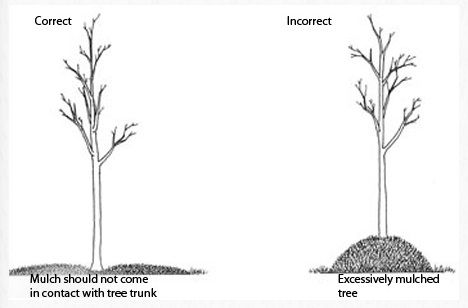 How to mulch a tree. Picture courtesy the Morton Arboretum, Lisle, Illinois